The Attention Tax
I’ve noticed a big change recently. Heading home at the end of the day, I’m more mentally exhausted than I’ve been at any point in my career. Some might say it’s age creeping up on me, or a four-month-old baby, but when I talk with colleagues and friends, a lot of people say the same: a busy head, intellectual fatigue, and an unsettled feeling that time is being wasted if agents aren’t working on something.
That surprised me, because AI has taken a lot off my plate, and it has enabled me to work on more things, bigger challenges and more intellectually demanding questions concurrently than ever before. Far from making us dumb, Claude, or an equivalent, lets people supercharge rather than diminish themselves.
But just because you can build anything doesn’t mean you should, and when such a breadth of options is possible, how do you decide on the right path? How do you see the wood for the trees when everything is becoming a forest?
In many ways these are not new questions… I started my career in strategy consulting and did a postgrad at business school, where I was taught that strategy is “the allocation of scarce resources”. Simple. Every framework explored how human capital, financial capital and so on were scarce resources that needed to be organised to achieve business goals, and almost all of them assumed that building things was the scarce part. That assumption, I believe, needs to be thrown out in an AI world.
That doesn’t mean strategy no longer matters. Far from it. But what’s scarce in my week now is less money or engineering time than attention, and the headspace to judge what’s actually working.
Wide, but not done
To borrow a phrase from one of my colleagues, James, AI has sent our ‘horizontal velocity’ through the roof: the ability to pick up one more thing, and then another, and say yes to all of them. Horizontal velocity feels great at first: more Claude sessions, more lines of code, more pull requests, the sense of progress…
But as any traditional project manager will tell you, more things in flight doesn’t necessarily mean more business progress. And I suspect this also contributes to what I described in my first blog in this series: the half-rewire that gives the perception of progress without necessarily translating into results.
Horizontal velocity is a great place to start, but what we’ve started to realise at Sidekick is that what matters more is ‘vertical velocity’: the speed at which a consequential piece of work, the kind somebody has to stand behind, gets taken all the way through and finished properly.
The numbers are a bit sobering. Of the roughly thirty projects I’ve personally started since July, perhaps ten have been truly finished. Four months isn’t long, and some of them were never going to be quick, but every week I find myself starting more new things, and the pile keeps getting bigger.
I’m a particularly bad offender here, but it’s a trend I’m seeing more generally, and it shows up in the small things too. Always-on agents review our logs, fix bugs and raise pull requests around the clock, but a person still reviews each one before release, so the queue has simply moved to the review end of the line.
In my first blog in this series, I wrote that we are all builders now, and that centralising our knowledge had cut the time we spend on coordination and planning. The first holds true, but the second needs qualifying: it did cut the coordination each piece of work needs, but we spent the savings on starting more work, and our planning meetings are now longer than they were.
More builders means more things started, and what I didn’t see was that the finishing would fall on the same few accountable people.
So why don’t we all just follow Revolut?
The company in Europe that’s done the best job of deciding what to back and what to stop, I believe, is Revolut. I’ve observed their journey from the very start, and I remember Nikolay Storonsky’s pitch back in 2015 at the Innotribe competition. Their pitch was compelling but narrow: cheaper FX when travelling. They were one of an array of startups there across crypto, open banking and payments, and there was no sense at that point that they were going to swallow it all (which they have since gone on to do, phenomenally).
What Nikolay has since built, and he’s used the word himself in a number of recent interviews, is a machine with very clear inputs, an intense focus on outputs and ruthless execution. Under their bets approach, anyone can raise an idea, a committee decides whether to fund it, and if so, a small team gets a modest budget and up to 18 months to prove it on Revolut’s common platform. Then there’s a single test: the growth in gross profit, ranked against every bet that came before. The top quarter get more investment and a larger team, and the bottom quarter are shut down.
AI has opened up the possibility of running the building half of that machine for many more teams. At Sidekick, an idea is quickly shaped into an intent, a spec and a plan, led by whoever raised it with the support of AI in the scoping, so that a team of agents can pick up the ‘bet’ and get to a prototype quickly, at ever-decreasing cost. (Don’t get me wrong, it’s not completely free: token costs can spiral if not controlled, and the frontier models are still expensive.)
But even if the building half is now within reach, AI doesn’t give you Revolut’s common platform, capital, or culture. And the judging half is still a work in progress for us, and I believe for most companies, because ‘judging’ is really two different jobs.
The first is checking the work: is this correct, is it compliant, and can I stand behind it as an accountable exec of the firm? This is particularly sharp for a regulated firm, where it can’t be handed off.
The second is choosing between bets: is this bet actually working, and does it deserve more? Revolut can make the choosing almost algorithmic because they have ten years of earlier bets to rank against and millions of customers to provide signal quickly. That’s where most others are at a disadvantage.
In a company our size, both jobs land on the plate of the same few accountable people, requiring their attention to both check and choose. That’s the pinch point.
Better tooling helps one person handle more, and over time more people can carry the accountability. We’re working on both. But neither grows at the speed of code.
Are we all just VC funds now?
I wasn’t expecting to say this, but my time in VC is far more relevant here than I’d imagined. At the core of the VC model is the power law: a fund takes plenty of cheap early shots, but it needs to believe each one could return the fund by itself, and the real work is concentrating behind the handful that might. The binding limit is rarely just capital: there are only so many boards a partner can sit on, and only so much attention they can give to each. The best firms concentrate hard on what is working (a16z apparently offered the Databricks founders $10m when they had asked for $200k), and they hold back reserves so that when something does work there is money left to double down.
I suspect a company now increasingly looks like a ‘fund’ too: product bets are the equivalent of the VC cheques, and the attention of our accountable people is the equivalent of the partners’ time. But it’s a harder fund to run. A fund can lose no more than the cheque it wrote, and each of its companies stands on its own, whereas our bets all sit on the same licence and the same balance sheet, and are signed off by the same people. And unlike a fund’s partners, our accountable people can’t step off a board.
The door to customers
None of this is fully in place yet, so treat it as early thinking. Writing it down has been a useful first step for me in working it through.
But the clearest way I’ve found to put it is this: in an AI world, starting something is close to free, but launching it is a commitment.
Before a bet reaches real customers, I want us to move as fast as the tools allow. Prototypes don’t need to sit inside the core ecosystem, they don’t need a business case, and most of them should be thrown away. They’re the ‘pre-seed cheques’… cheap, plentiful and ring-fenced, and they never reach customers.
The launch is where that changes. In a regulated firm, once real customers are using something, it becomes a near-permanent claim on someone’s headspace. It needs an accountable exec to stand behind it, it attracts regulatory oversight, and if it doesn’t work out, it’s often complex and time-consuming to switch it off. So the real cost of a bet is no longer what it takes to build. It’s the accountable attention it will need for as long as it lives. Call it an attention tax, and it’s paid every month the product is live.
That makes the door to customers the place where strategy now sits, and I think three things need to happen there.
Firstly, anything going through it should be built on a common platform wherever that makes sense, using the distribution, security and permissions we already have. This aligns with Revolut’s learnings, and it’s also what makes a bet cheaper to check as well as cheaper to build.
Secondly, the scale of the potential outcome needs to be balanced against how long the bet will linger. Some things are genuinely cheap to keep, such as a feature inside a product we already run, which needs no new permission or new accountable owner. They can be small and can go out fast, perhaps first as an opt-in early-access feature.
But a new financial product that brings years of accountable headspace and regulatory oversight has to be capable of meaningfully shifting the company. A hundred 1% bets is a disaster, because it’s a hundred slices of headspace. Ten 1% features and three or four bigger bets are far better, because the small ones are cheap to keep and the big ones are worth the headspace.
Put prize size and staying power side by side and you get a nice two-by-two (I mentioned I started my career as a consultant…!). A big prize that’s cheap to keep is brilliant, and rare. A big prize that lingers is a real bet, and there should only be a few of those, backed hard. A small prize that’s cheap to keep is a quick feature: ship it. And a small prize that lingers is the trap.
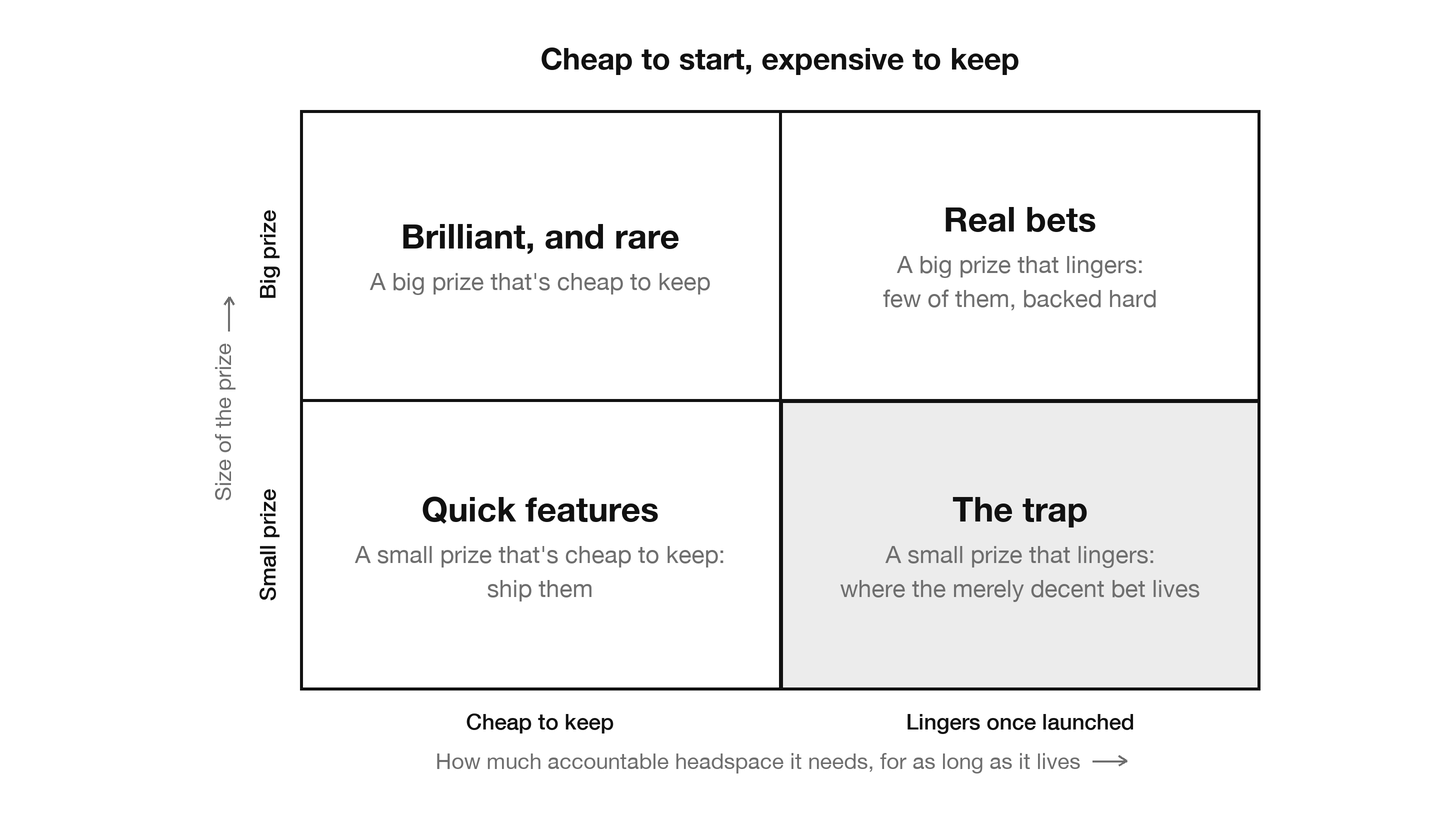
Thirdly, we need to figure out a way to agree at the door when we re-score the bet and what would make us stop, because nobody really knows the size of the prize at launch, and the trap is where half-working bets end up rather than where they start. That also puts a natural limit on how many lingering bets one person can carry (I suspect two to three per accountable exec, which would mean stopping some of what’s in flight), and leaves some headspace free to back a big bet the week it starts working.
The bet that worked a little
The failed prototypes cost us almost nothing. The one I worry about is the merely decent one that worked a little, got kept because it worked a little, and slowly absorbed the attention the best idea needed. In venture terms, it’s the portfolio company that will never fail and never return the fund, and that still takes up a board seat for a decade.
Even Revolut’s machine is vaguer here. The top quarter are scaled and the bottom quarter are cut, but of the bets in the middle Nikolay says only that sometimes they keep the team and sometimes they don’t. And where customers already rely on a product, it isn’t switched off at all: they stop investing in it and carry on maintaining it. Revolut can afford to do that. A smaller company can rarely afford it, and that’s where the long tail starts to drag.
We’ve had our own examples of this, long before the AI boom. We built a lot of products in the early years of Sidekick, some of which worked and some of which didn’t. Our Lombard lending product, for instance, had huge promise, but it never took off the way we hoped. We still offer it today, and as long as it is available to customers, someone accountable has to stand behind it. It only takes a small proportion of my headspace each month, but it is still headspace, and every product like it takes its own slice. Whether to back it properly or keep it ticking over is exactly the kind of decision this post is about.
What stays scarce
The definition of strategy I learnt as a fresh-faced grad still holds, but the scarce resources we’re allocating have changed. As we work through our own refounding, we’re trying to build our own version of Revolut’s machine at the size of ‘fund’ we actually are, and we’re not there yet. What I’m trying to learn in the meantime is to start freely, be far more deliberate at the door to customers, and keep enough accountable attention in reserve to back the few things worth backing, letting the rest go, however good the demo looked.
With luck, I’ll head home a little less tired.